Showing posts with label dali. Show all posts

Friday, March 9, 2007

More on Dali's 50 Secrets

I'm continuing to read further, but I haven't gotten to a point where the Secrets arrive at their next conclusion. Because that's the case with these things. Dali may have enumerated 50 of them, but the Secrets seem to be falling into groups of things. I don't have the book immediately to hand, but all of the bits about creating 5 different araneariums (spider-habitats) to convince webs to be spun so that you can look at the landscape through them... well, let's just say that I respect spiders, but I'm not running out to cultivate close relationships with orb-spinners.

Just like the Bible and the IRS Tax Code, you can interpret the 50 Secrets on a number of different levels. There's the words exactly as written, which in the hands of practiced occultists become a path toward the Great Work. Any occultist who actually performs the steps as written exactly has my respect in pulling it off, but also my sympathy... just because a painting Master tells you to go do something doesn't mean he was a) talking to you, b) telling the truth, or c) worth listening to as much as his work is worth looking at.

Dali the mad genius?


Dali's worth listening to, but you need to also think for yourself. While I'm sure that the egomaniac/marketing side very genuinely believed that you needed to listen exactly to Dali in all of these things, I'm sure that the actual artist portion of his persona would have delighted in the fact that he had found someone with enough strength of character to stand up to him, and yet wisdom enough not to dismiss him just because of his stylized fantastical elements.

Part of the problem is that, as with any inspirational writing, you need to be able to sift through what is actually said to get at the wellspring of meaning and inspiration which prompted the writing. Dali's tapping into some very essential, spiritual truths here, but the manner in which he himself manifested the realization of these spiritual truths is not as universal as the truths themselves.

Keeping my head


As it always it. Reading is not permission to close your mind and stop thinking for yourself. However, setting aside your preconceptions to at least give serious consideration to even the most fantastical proposistions is what allows us to come to know in some small way these other creatures we name as fellow humans. So we continue reading through these secrets with one eye on the literal expression for what it is, and the other eye on the probable sources of inspiration or motivation for what they are. Where the literal cannot serve us properly, then we are left trying to approach a personal apprehension of the truth that inspired, say, the fish eyes or the sea urchins. Whether we can or not is the test of both our ability to comprehend and Dali's ability to communicate.

I'll analyze more of the secrets when I get far enough along to be able to see where the similar points end and where new motivations begin to pour through. So far, they're mostly concerned with items like controling your sex life to channel or retard the creative energies of the libido. Taoist monks practice celibacy along with meditations and diet as the keys to prolonging life eternally. (Once again, without sex, is life worth prolonging that much?)

They also seem to be about finding the right mental/spiritual balance with regard to the painting. Not spending too much time. Not over-finishing. Not letting the details bog you down until it's time to worry about the details, and then knowing when the painting is finished.

Interesting theories. When I'm done with the whole book I'll go back and pick apart each of the secrets.

Thursday, March 1, 2007

Secrets 1 - 5

The first secret of Dali's Magic Craftsmanship is rather straightforward. There are five different types of brushes, and he outlines what each brush shape and type is used for. He describes these in terms which match the 'Fat over Lean' rule of oil painting, although his language is a little more colorful. And he describes certain ways of working with each brush.

Secret 2


Very straightforward, until you get to the way he describes using a fan brush (Secret #2) for blending by propping your off arm (being left handed, my off side is my right, but Dali writes from a right-handed worldview) on your off leg which is resting on a springboard so that you can bounce it quickly whilst holding the 'on' arm with your off hand, and allowing only your painting wrist to move, all while bouncing and trying to attain the speed and fluttering of a hummingbird.

Mmm hmmm. I'm not sure where allegory ends and technique begins, so I shall one day have to try this.

Dali also goes into the shape of the stroke that each brush type makes. From a technical point of view, this chapter begs to be returned to and experimented on, because as a single secret, it contains a wealth of technique which must be practiced.

Secret 3


Secret #3 is to pause the passion of creation before beginning so that you may put yourself in the right frame of mind. The kind of pause is the deepest sleep you can attain. "Sleep on it" seems to be the advice. This is pretty much in keeping with sage wisdom of the ages which has nothing to do with painting, but it does establish quite firmly the fact that oil painting is a process where a certain level of patience is called for. That and a painting whose vision will sustain you through the whole process.

Dali further goes on to refine his definition of this kind of sleep by stating that artists need to learn how to use 'slumber with a key'. Essentially, get in a semi-comfortable position and hold something in your hands which will make a loud racket when it is dropped. Then go to sleep. As you relax, you release the object, which falls and makes the racket, and you are now wide awake. That length of time, mere seconds, is the point. You're hitting a 'refresh' button on your brain, not indulging in a luxurious nap.

Secret 4


Here we begin to get "Daliesque". Secret #4 is the slumber of the sea urchins. Dali describes a certain kind of specific meal of seafood which is required, and he singles out a specific type of sea urchin. Presumably this is for the narcotic effects of this particular creature. You then set yourself up to look at your unblemished canvas and to study it serenely, meditating on it almost, with no artificial lights present. Do so for a full afternoon on into the evening just a few minutes past the time that it's too dark to see. You are, essentially, giving yourself the luxury of visualizing the painting which you will embark upon. If a full five hours seems to be too much time, recall that some paintings take excruciating amounts of layers and time to complete, so it is a small amount of time in the extreme.

This reminds me of the athletes and warriors mindset, where a battle or an enterprise is won before you even begin to try. It's acquiring the mindset of the desired result, and getting in the right 'game space', artistically speaking.

Secret 5


Here we begin to enter the bizarre realms, but only slightly. With this secret, Dali begins to have us cast a spell upon ourselves. Or more properly, we've already entered the altered state of consciousness. Now we're supposed to eat a meal of perch and save three of the eyes. (Taking one from your wife's fish with a smile, so sayeth the Master). For western cuisine, we tend not to eat the eyes, so I'm thinking for myself it will be three white marbles instead.

He describes a practice whereby you position two of the eyes so that you 'stereoscope' them together into the optical illusion of one, and you hold the third eye in the Y cleft of your crossed fingers. The point is to fall asleep while being confronted with the fact that your senses are lying to you. Yes, lying. He's aiming for a state of mental dissociation, a sort of mental trance or mental realization that the senses of humans are fallible.

Magically, it makes sense. By that point and time in the process you've built up quite the visualization, and the painting is literally straining to get out. Like putting a nozzle on the garden hose, by restricting things slightly it builds up the creative pressure and the urge of the concept to realize itself in manifestation. It also begins to trick the ego to let go and get the hell out of the way so that the right brain can work without interruptions.

I can relate to what's being aimed at here. There is a brain-wave pattern which I have always associated with "successful" periods of making art. I don't know which greek letter is the proper one to ascribe to those states of mind, but I do know for certain that it happens when you can successfully disengage your Critical mind, your Censor, your Ego, your Left Brain pattern of thinking. And that seems to be what Dali is aiming for, the hypnotic pattern almost where time ceases to be noticed and the channel is opened to the concept coming through. It's that mindset which allows days to go by unnoticed, and is also why many artists have a reputation for not eating... they fail to notice that the body is hungry, because they have stepped out of the way and are allowing creation to happen.

Yeah, I've been there. Not that anyone would accuse me of forgetting to eat. ;)
So far, even with all of the babbling and surrealist writing styles Dali is not completely off of his rocker. Beyond this secret we end up with lots of quotes of babbling folks, but there is a thread of sanity linking them all. He's -not- mad. Not quite, but he definitely lives next door.

Dali's 50 Secrets of Magic Craftsmanship


It's here! Oh frabjous day! Calloo! Callay! He chortled in his joy.

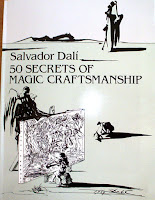
Yes, Dali's 50 Secrets of Magic Craftsmanship were just handed to me by the kind US Postman delivering Amazon's box o'goodies for me, including ART & FEAR: Observations On the Perils (and Rewards) Of Artmaking, by David Bayles & Ted Orland.


Also arriving today was THE VIEW FROM THE STUDIO DOOR: How Artists Find Their Way In An Uncertain World, by Ted Orland, one of the two authors of ART & FEAR. I have never read it, but I liked Orland's efforts on ART & FEAR, so I figured I'd give him a shot with his followup work.

ART & FEAR was a book I owned before, loaned out during the Great Sleep when my artistic side was encouraged to give up and let me be 'normal' with a 'real career'. Alas, like many great books, the loan never returned. But I'm not sad... it means that the word is getting out, and I've got a new copy of my own.


Back to Dali


My old Spanish Professor, Vilma Manzotti, PhD, at the State University of New York at Potsdam College, once chided her class of American students gently about the fact that we knew nothing about how to read a book. All books need to be read starting from the front cover, because there is vital information being missed. The Table of Contents sets out the outline of the work and helps put the reader in the right frame of mind. Dedications can be important, too, sometimes. And Forewords and Prologues all matter, because if they didn't they wouldn't be in the book.

So, with a nod to the wisdom of Vilma, I began at the front cover. Artwork by Dali himself. Pen & ink, thick and bold and fine and scratchy. An angelic figure behind a canvas where an artist is working, other "figures" or vaguely anthropomorphic ink swathes, stand about in various poses. Interesting to me is that the Angel figure, what I interpret as the Muse, is not looking at the painter or the painting, but is instead turning aside and reading a book.

Ahhh, Dali, your sin was that you knew your own greatness.

Inside the front cover we find a color plate of "Portrait of the Back of My Wife Contemplating Architectural Form". Fitting that Gala should make a very early appearance. Another page in we find another pen & ink drawing, "Port Lligat Madonna Help Me", then the Title page where I find that this is a translation.

Ah hah. You know how I said that art seemed now to be gathering to itself all of the component bits of my somewhat disjointed life? I was in Vilma Manzotti's classes for a reason, that being my undergraduate degree is in Spanish Literature. I'll read this through first in English, for the purposes of making an approach to Dali's writings, but I will have to secure a copy for myself in its original Spanish. Luckily, I am fluent in Spanish, and luckily still, I've had great philosophical discussions and dialogues with other academics and my professors about how translations must make a choice... either they have to be true to the literal words and translate as exactly as possible (a very scholarly approach), or else they have to translate the meaning of the text itself and sacrifice the exact language used (a very artistic approach). The best translators can use a little of both, but in every case, whenever you translate something you are completely dependent upon the lens of the translator to make the right choices, to be able to identify and see what is truly important to the text, to the author, and to the potential readers.

Best to always read it in the original language. Which is something the prophet Mohammed knew, and knew well, for he lay down the edict that the Q'ran must only be read or studied in the original language it was written in. Today, we call that Ancient Arabic, and student of the Q'ran must learn how to read it fluently. I'm willking to bet that Dali toyed with the idea, or would have agreed with it philosophically. I never met the man; more's the pity, but if I had to choose between meeting Pablo Picasso or Salvador Dali, I would choose Dali (although I know I might well have been disappointed by the interview, if he would have said more than 2 words to me at all).

Reading On


I do see that there are notes in the edition which tell us that the Dover edition has been slightly altered from the original... Gala's painting was not originally on the inside cover. My print production background tells me that it was cheaper to print the color pieces on the covers instead of putting a signature of color in the middle of the book, so this makes sense.

The other thing they mention is that in the original, Dali's name appeared without any accents, just as I've been writing it for fear of losing the accent in translation across ASCII and Unicode browsers. They put all of the accents in when they reprinted it from the original. DalĂ­. Interesting that in Dali's own time they didn't put the accents in... I'm not sure if this was an oversight or a preference of Dali's. More research would be needed, but I'm working on other things.

Dedication


Dedication follows, where Dali describes what he wanted at each of the decades of his life, and how things have grown. He also describes his mission "Now at forty-five" as being to paint a masterpiece so that he can save Modern Art from chaos and laziness. He swears he will succeed.

It's an interesting thing, really. Dali is known and talked about as a man of tremendous arrogance and ego. I'm not so certain it's completely undeserved, and that must be difficult to live with when you just want to wipe the smirk off of the man's moustachioed face.

Then follows a list of all of the 50 secrets with their titles, numbers, and page references. It begins with "1. The secret of the five different movements of the five types of brushes." and it ends with "50. The secret of the angel." Now, oddly enough, my mind is immediately drawn back to the front cover. I want to get to 50 because I suspect that he's alluding to the angel on the cover.

In skimming through the secrets, I see lots of references to weird and obscure things. Some of them jump out at me, though. Like this one. "19. The secret of learning to paint before knowing how to draw." Well, if the title alone is indicative (I highly doubt it's the whole shebang) then this one speaks directly to me. I don't yet consider that I know how to draw. Yet it's heartening to see that this might actually be a good thing, at least according to Dali.

Prologue and Quintessence


Stray comments about Dali having been at least passingly familiar with the occult from Guru Dave begin to draw attention to certain passages. Basically, Dali is setting down his parameters for what makes the artist great, and he says that it's the point of the book, which is revealed at the end in two lines. "...he will find it exactly in the last two lines of this book." Lines? Or lines? Word or sketch, I'm keeping my mind very open.

But it's a good point. I remarked to Dave that I pass by a fine art gallery in South Norwalk every day, and they regularly change out the paintings that they have in the front display to try and entice folks to come in. I've already seen that some of the works seem to have captured something of the spirit in them, while others seem to be merely color studies of various subjects in pretty frames. Some seem to be art, others seem to be paint on a canvas. Perhaps Dali will give me a better vocabulary to make my explanations from.

We shall see.

And now, on to the rest of the book.